As a key part of a larger plan to improve the most vulnerable areas of the Dutch coastal defence, Katwijk’s coast proved to be a particular challenge: how to add safety, without sacrificing the key qualities of the town, but rather add more quality instead? We researched the relationship between the town and the beach, and used the reinforcement to create a dune landscape that feels completely natural while, in reality, it houses a hidden parking garage behind a dyke.


With a series of new public spaces, we have transformed the Utrecht station quarter into a safe, inviting, and seamlessly integrated part of the city. The design was prompted by the need for expansion as desired by various stakeholders in the area. We linked this expansion to the city’s interests and to the restoration and utilisation of valuable historical structures. This approach enabled us to create new, attractive connections, enhance social safety, and establish high-quality, nature-inclusive public spaces in and around the station quarter.


Anchored by the new London Museum move into the iconic Poultry and General Markets, along with the opening of the Queen Elizabeth Line at Farringdon and the relocation of market functions, Smithfield will experience radical transformation over the coming years, evolving from its historic identity as a meat trading hub into a world-class, 24-hour cultural destination.

In collaboration with Hawkins\Brown, we are working on an ambitious public realm scheme that aims to create a unified, pedestrian-friendly and multi-functional public realm where Smithfield’s multiple histories and contemporary cultures intermingle.


Cutty Sark Gardens is a public space, inspired by tides, that forms a hybrid between a square and a garden. By embracing and celebrating opposites, Cutty Sarks was designed to create a comfortable place to stay, yet fully connected with the continuous change and flow around it.


Fontys Hogescholen’s Rachelsmolen campus in Eindhoven is undergoing a remarkable transformation, evolving from a secluded island in the city to a captivating and inspiring educational environment.

The vision is to create a campus that revolves around human interaction, fostering innovation, experimentation, and entrepreneurial spirit through vibrant cross-pollination. We have undertaken the design of this ambitious new campus in collaboration with NUDUS, Barcode Architects and Hollandse Nieuwe interior architects.


Rouen Rive Droite station is a major transport hub with over 6 million annual passengers, located in the densely built historic city centre of Rouen in Normandy. The predominance of road infrastructure and the presence of numerous visual barriers hindered the mobility of soft modes and severely limits the opportunities for using the public realm. The station quarter has undergone a profound transformation to improve the comfort of use, accessibility of public transports and to create an attractive entrance into  the city.


In a short span, Hengelo’s city centre has undergone a comprehensive transformation. This gives Marktplein square a new role as an active, future-proof, and appealing destination. The project marks a milestone in the transformation and redevelopment of the city centre of Hengelo as it transforms the biggest open space of the city into a green and active heart for all.


Extending the plateau’s green and blue infrastructure into the urban heart
 

In collaboration with a team led by LIST architects, we support EPA Paris-Saclay in shaping the next chapter of the district, realising the vision of a vibrant, climate-resilient, mixed-use urban quarter: a place creating fruitful connections between city and nature and strengthening the conditions for serendipity, collaboration and intellectual cross-pollination whilst offering spaces for leisure, sport and community life.


At the heart of Wattland a generous wetland creates a distinctive living environment that honours the site's original landscape
 

At the meeting point of urban life, water, and landscape, the former industrial area of Keerdok is being reshaped into a vibrant and green mixed-use neighbourhood: an appealing and nature-inclusive destination for recreation, culture, living and working.

Commissioned by the City of Mechelen, Cores Development, and the developers’ consortium ION-NEW, we have led the transformation of Keerdok’s public realm, playing a pivotal role in crafting a new identity that supports the city’s growth and future ambitions.


Mechelen, with its rich history, is a city where the echoes of the past resonate throughout the historic inner city. However, by the late 20th century, the area’s charm and identity had been obscured by a series of pragmatic decisions that eroded its character and liveability. An initiative to reintroduce water into the city centre led to a design competition. We were selected as the winner, still a fledgling Dutch design firm at the time. This marked the beginning of a lengthy sequence of collaborations where Mechelen’s aspirations and our expertise complemented each other seamlessly.


The foundation of this collaboration lays in the endeavour to bring water back into the city centre. Much of modern Mechelen’s city centre is essentially an island surrounded by the Binnendijle and the later-added Afleidingsdijle waterways. Branches of the Dijle extended deep into the city, serving as both drainage and sewage systems. Consequently, in the late 19th century, it seemed logical to cover these waterways as part of a modernisation effort, promoting hygiene, mobility, and urban density. However, this came at the expense of the city’s historical structure and culture. In the late 20th century, priorities shifted. As part of a European collaboration, a design competition was held for the first phase of the project to reintroduce water to the Melaan, which, at the time, was a vast parking lot.

Creator of meaningful places
 

Melaan

Our design for the Melaan was straightforward: bring back the water on the east side and create two levels along the quay to form pleasant movement and relaxation spaces. This design introduced numerous elements that would subsequently become permanent fixtures in the city’s layout. New bridges were deliberately designed with clean lines and finished in steel to contrast with historical elements like the newly unveiled Minderbroedersbrug. A motif of concentric rings, evoking the ripples on water surfaces, was introduced on concrete bands for this project as well. It became a recurring theme for unveiling the concealed waterways throughout the city.


With the successful completion of the Melaan project, which laid the groundwork for our enduring collaboration with ARA, the principles of the Melaan design were progressively applied throughout the rest of the city centre. This ongoing collaboration provided a potent combination of structure and flexibility, facilitating the integration of new perspectives and ecological aspirations.


Creator of meaningful places

Korenmarkt

The design principles were not limited to specific water projects; they also found application in revitalising historically valuable locations that had ceased to serve residents effectively. The Korenmarkt is one such example—a funnel-shaped street leading to a triangular square, considered the cradle of the city. A stepped square was created to reveal the slope’s presence, while generous green spaces, encircled by seating areas, provide both a lush ambiance and efficient organisation. They frame and demarcate surrounding terraces and routes for traffic flows.


Rediscovering Mechelen's oldest square

Located in the heart of Mechelen, Korenmarkt is considered the city’s origin. However, the value of the place to the city had been lost over time. We took up the challenge to transform what had been relegated to a widening road with some parking into a valuable square with accommodation quality and an appreciation for history.

Learn more


Rik Wouterstuin

Another instance is the Rik Wouterstuin, which serves various needs within a public yet compact courtyard garden. What was once a secluded inner court, has been transformed from a parking area into a public green-blue garden, fostering creativity and play. The central feature is the stream itself, gradually turning greener as it flows through the garden and ending in a reed bed. Adjacent is a green garden that, despite its compact size, invites a variety of experiences including: facilities for creative sports and play, benches for interacting with the water, and a sculpture by Rik Wouters, along with mural paintings as cultural elements.

Creator of meaningful places
 

Vliet Zakstraat Muntstraat

Continuing from the Rik Wouterstuin, another waterway has been exposed from the Zakstraat, creating a new passage toward the Muntstraat. This stretch continues the green-blue character along its length, doubling as a buffer for runoff water from the surrounding areas. This visible waterway is essentially a new concrete structure placed on top of the historical waterway. In contrast to the historical stream, green elements dominate here, emphasising biodiversity. Reed beds purify the collected water and connect the adjacent green gardens.

Existing design motifs, such as water ripples and steel bridges, have been further enriched with new motifs, like the fences, applied in various forms but forming a cohesive family.

 
Whether holding water permanently or temporarily, retention and detention ponds delay runoff, filter pollutants, and allow infiltration
 
Creator of meaningful places

Onze Lieve Vrouwenstraat

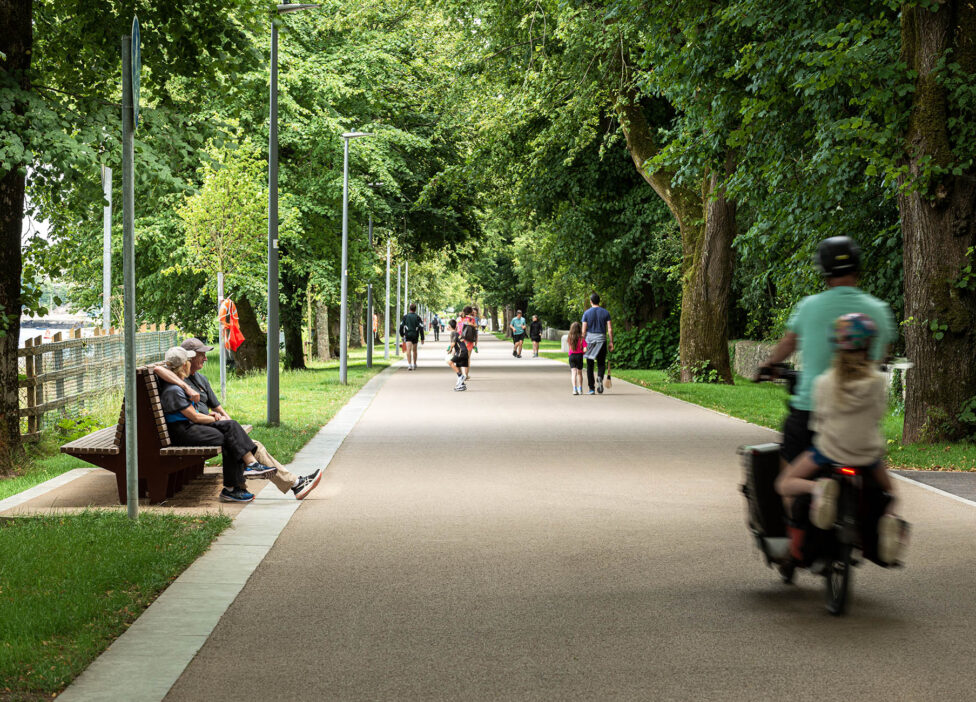
Onze Lieve Vrouwestraat is one of the city’s most prominent and characteristic shopping streets. Until recently, this connection between the train station area and the oldest part of the city, near the Korenmarkt, was open to vehicular traffic. With a newfound focus on pedestrians and cyclists, an opportunity emerged to apply the principles of greening and sustainability here as well. The design thus reserves ample space for pleasant green relaxation areas. This results in a considerably more enjoyable living environment along the 1.5-kilometer length of the street.


The collaboration in Mechelen has yielded a wide variety of complementary projects. In addition to various older and recent projects within the city centre itself, we also think and design for projects outside the city centre, including the Keerdok area, where industrial heritage is being transformed into a residential neighbourhood.


Discover other projects


Rediscovering Mechelen's oldest square

Located in the heart of Mechelen, Korenmarkt is considered the city’s origin. However, the value of the place to the city had been lost over time. We took up the challenge to transform what had been relegated to a widening road with some parking into a valuable square with accommodation quality and an appreciation for history.

Learn more