October 5, 2026 Awards
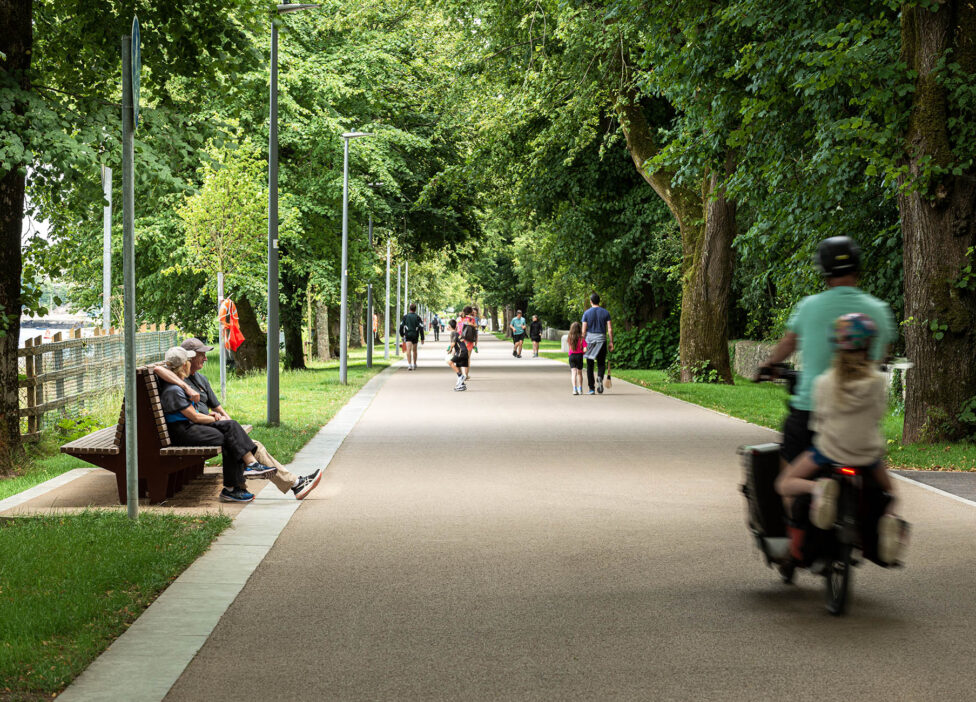
Marina Park, located on the south bank of the River Lee, acts as a catalyst for the transformation of Cork’s docks. While many port conversions have led to new urban developments, it is unusual for industrial areas to begin their transformation by creating a park.
Contemporary parks must offer water-sensitive solutions. Since the site was once part of the river’s floodplain, it was only logical to transform it into a river park. The water areas that articulate the park evoke the historical transition of the riverbank, which over the centuries has progressively gone from being clogged land to land reclaimed from the river, although it has always remained under the influence of river infiltrations.
From west to east, the park transforms from a cultural environment to a natural one. The area to the east of the Gaelic football stadium has a central square flanked by red industrial buildings, while moving eastwards the park becomes a wilder and more ecological area, with a winding path that reveals historical vestiges framed by the plant landscape.
A scenic promenade has been set up along the River Lee for cyclists and pedestrians. The Marina Boulevard, directly linked to the water, offers a space for active movement and contemplation of expansive views over the river.
Full of Life, the seventh edition of Landscape Architecture Europe, celebrates landscape architecture as a vital force for life, beauty, and transformation. Featuring 42 diverse projects from across Europe—ranging from built environments to conceptual designs—this richly illustrated volume explores how spatial design can foster care, collaboration, and change amid social and ecological challenges. Accompanied by insightful essays and portraits, the book highlights how landscape architects embrace diversity, surprise, and uncertainty to shape resilient and inspiring spaces.
OKRA is proud to showcase two key projects:
Contemporary Landscape Architecture: Masterpieces Around the World is a global showcase of exceptional landscape architecture projects that redefine outdoor spaces as independent, human-centered environments. Whether integrated with buildings or set in natural surroundings, these designs bridge nature and architecture, balancing aesthetics with functionality. In the face of climate change, the book emphasizes the discipline’s vital role in conserving resources and creating sustainable, socially inclusive green spaces. A rich source of inspiration and reference, it captures the full spectrum of contemporary landscape architecture worldwide.
In this publication, OKRA is proud to showcase Catharijnesingel (Utrecht) project. In the 20th century Catharijnesingel became Catharijnebaan: an unattractive urban highway dominated by asphalt and concrete. When offered the chance to revert that development, we took the opportunity to push the idea further to its full potential. As the water returned to the historic Canal area, it brought along a new natural park route right into one of the busiest areas in the Netherlands. The result was an urban landscape that was fully connected to the past, the present and the future.
A landscape-based approach can help address key spatial and scenic challenges in a densely populated region of Zuid-Holland.
We are proud to share the publication “Mission Knowledge Region by the Sea 2070” , produced in cooperation with Delft University of Technology, Atlas Research and The Global Institute on Innovation Districts.
By using a landscape approach, we are able to identify opportunities to improve the existing situation while incorporating housing, mobility, economy, water, nature and landscape in an integral way. The existing landscape and urban structures help us define opportunities for spatial-economic development and highlight spatial conditions that ensure a productive, socially and ecologically inclusive and future-proof direction for smart growth.
The collaboration aims to develop building blocks that serve as future perspectives; a unifying narrative that encourages long-term cooperation as a basis for sustainable knowledge sharing and resilient change.


Second Glance is the sixth yearbook by Landscape Architecture Europe, showcasing over sixty innovative projects from across Europe. Building on the foundational design actions of care, create, and act introduced in the previous edition, this volume explores how landscape architecture contributes to resilience, beauty, and survival in the face of global challenges. The projects are organized into four thematic sections: Europe’s Commitment – Tackling grand societal and environmental challenges; Europe’s Strength – Enhancing public spaces as vital community assets, Where We Live Today – Using landscapes to expand perspectives and provoke thought.
What We Need to Develop – Designing landscapes for sustainable urban futures. This edition reflects on the urgent role of landscape architects in shaping a habitable environment for the coming decades.
In this publication, OKRA is proud to showcase Cadzand-Bad (Netherlands) project. We integrated the need for coastal reinforcement – part of the National programme to turn the coast into a super-storm proof zone – by upgrading the public space. In doing so, we realised a high-quality and attractive new élan for the entire village, with a diversity of atmospheres in which ecology and coastal defences are an integral aspect of the design. The renewed Cadzand-Bad is safe and attractive year-round for residents and tourists alike and is recognisably linked to its surroundings. The success of the interventions forms a solid, widely supported basis for the ground rules of future developments.
The second book in the series about OKRA landscape architects.
In the quarter of a century of its existence, OKRA Landscape Architects has proven itself at home and abroad with valuable visions and designs for public space. Designs that testify to an integrated approach to city and landscape. Today’s problems are tackled with well thought-out solutions, with care for the historical lines and with fresh, original designs in which the human dimension is ultimately decisive.
This monograph discusses the most important projects of the last ten years and provides background to the work. Equipped with beautiful photos, impressions and plan drawings, the book gives a good picture of an agency that started as a group of friends of talents, but has now become a leading international professional occupation.
In this book, the work of OKRA is considered and placed in the context of the development of Dutch landscape architecture. For the essay, Noël van Dooren spoke to partners and employees of OKRA, viewed projects, read their articles and studied their designs. In line with his research into representational techniques in landscape architecture, he became fascinated with the use of form and the way in which OKRA presents that form in images. That is one of the characteristics that distinguishes OKRA from other firms, including those firms that, like OKRA, arose at a time when the majority of today’s leading landscape architecture firms were founded. He also discovered the other side of OKRA’s work. It is not about form, but about time, use, flexibility and the development of new concepts that may never be built.
OKRA wants to do better than average. And the agency has proven that it succeeds – as evidenced by the many awards it has won. OKRA links current design practice to a convincing own vision. It makes stories and broad outlines tangible and cherishes the city as a pleasant place to stay.
Both nationally, with The Stationsplein in Enschede, the inner city of Zutphen, the quay of Doesburg, the Domplein in Utrecht, Van Heekplein in Enschede and the Westerkade in Rotterdam as well as internationally: the inner city of Mechelen, the riverbank in Holstebro in Denmark and soon Wellesley Road, in London Croydon, OKRA represents design of public spaces in the city.
Cathelijne Nuijsink interviewed OKRA’s partners and described ten important projects.

